

How long does articulation therapy take is the question Jill Dews hears from nearly every family at Let’s Talk Speech and Language Therapy. Jill Dews, MA, CCC-SLP founded Let’s Talk in Mission Viejo in 2002. She has helped families in Casta del Sol, Canyon Crest, and Pacific Hills answer this question for more than two decades. This article covers the main factors that determine treatment length and what progress looks like at Let’s Talk.
Parents ask about timelines because they want to plan before committing to treatment. The honest answer is that some children complete articulation therapy in a few months while others need a year or more. The difference between those outcomes comes down to specific factors a good evaluation will identify from the start. Understanding those factors helps families serving Mission Viejo and South Orange County set realistic expectations before the first session begins.
What Articulation Therapy Actually Treats
Articulation therapy targets the way a child physically produces speech sounds. A child with an articulation disorder substitutes, omits, distorts, or adds sounds in ways that affect clarity. Common targets include sounds like S, R, L, TH, SH, and CH, which develop later and cause difficulty when they fall behind.
Not every sound error carries the same severity. Some children have one or two sounds that are slightly off. Others have patterns that affect nearly every word they produce. The scope of what needs to be addressed is one of the biggest factors in how long therapy takes. Jill Dews assesses this carefully during every initial evaluation before discussing any treatment plan with the family.
The Main Factors That Affect Treatment Length
Treatment length in articulation therapy follows predictable patterns based on what the evaluation reveals. Parents who understand these factors go into therapy with realistic expectations. They also tend to see better outcomes because they know what to look for as their child progresses through treatment.
- Number of sounds targeted
- Severity of the errors
- Age at the start of therapy
- Frequency of sessions
- Consistency of home practice
- Stimulability of the target sounds
These factors work together rather than in isolation. A child with one mildly affected sound who starts early and practices daily may resolve in eight to twelve weeks. A child with multiple severely affected sounds who starts later and practices inconsistently may need twelve to eighteen months or more. Jill Dews maps out a realistic timeline for each child at the end of every evaluation at Let’s Talk.
What Progress Looks Like Over Time
Articulation therapy at Let’s Talk follows a predictable progression even when timelines vary between children. Understanding that progression helps parents recognize when their child is moving forward and when something in the plan needs to change.
| Stage | What Happens | Typical Timeframe |
| Sound establishment | Child produces the target sound correctly in isolation | Weeks 1 to 4 |
| Syllable and word level | Sound holds up in simple words and syllables | Weeks 4 to 8 |
| Phrase and sentence level | Sound stays consistent across phrases | Weeks 8 to 16 |
| Conversation level | Sound generalizes into everyday speech | Months 4 to 12 |
| Discharge | Child uses sound correctly without prompting | Varies by child |
Progress through these stages is not always linear. Some children move quickly through early stages and slow down at conversation level. Others take time establishing the sound but generalize quickly once it clicks. Jill tracks each child’s progress at every session and adjusts the plan when the pace changes.
How Home Practice Affects the Timeline
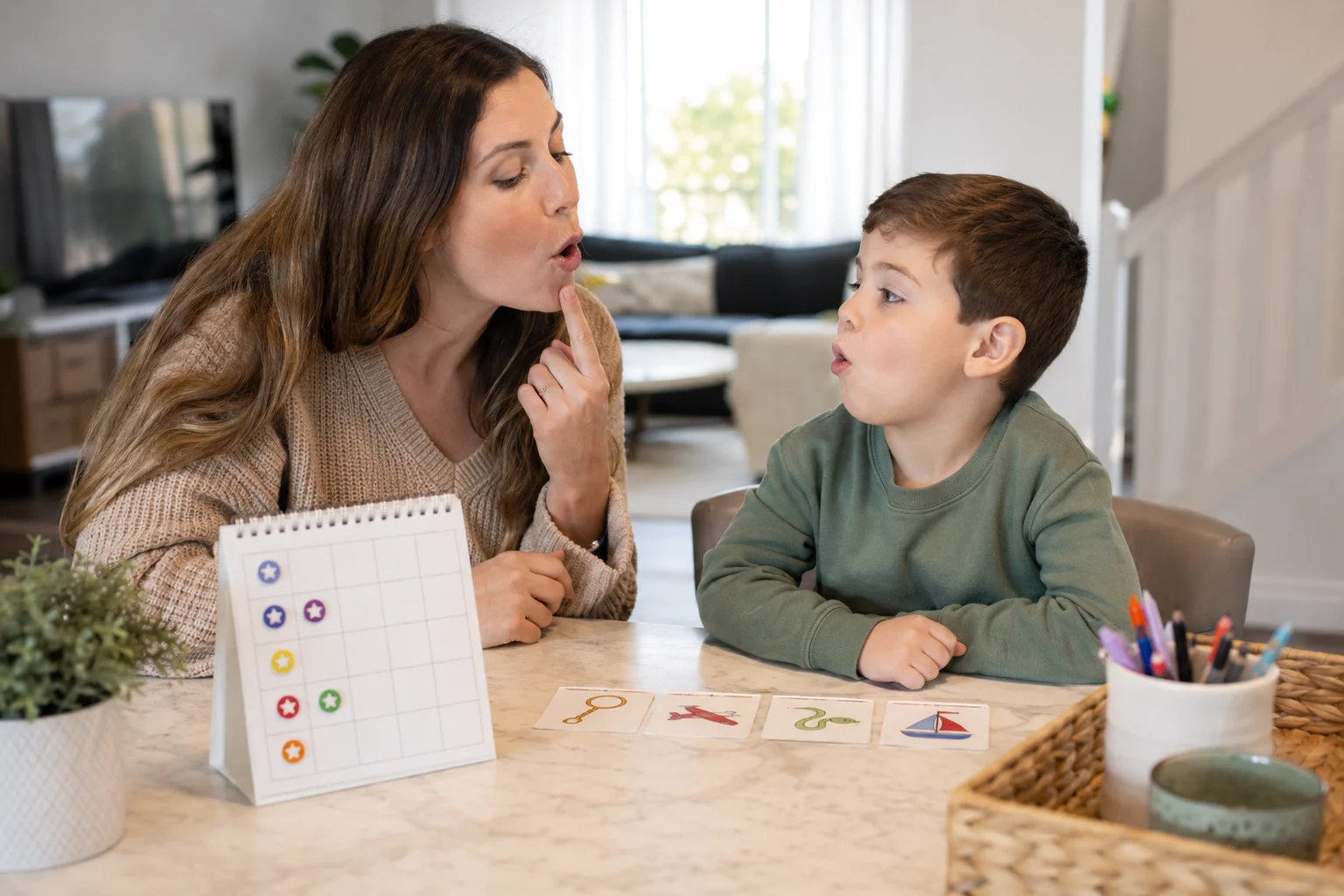
Home practice is one of the most controllable variables in articulation therapy. Children who practice consistently between sessions move through the stages faster than those who only work on sounds during clinic time. Five to ten minutes of daily practice makes a real difference in how quickly target sounds generalize into everyday speech.
Parents who engage actively in home practice at Let’s Talk see their children progress faster on average. Jill builds a specific home program for every family at each session and adjusts the targets as the child advances. The program fits inside existing daily routines rather than requiring a separate dedicated block of time each day.
What Happens If Progress Stalls
Stalled progress is not a failure. It is information. When a child stops advancing at the expected pace, it usually signals that the treatment approach needs to change. Jill Dews monitors progress at every Let’s Talk session and makes adjustments before a stall becomes an extended plateau.
Common reasons include insufficient home practice, a target that is too difficult for the child’s current level, or an underlying issue that was not apparent during the initial evaluation. Jill addresses each of these directly with families. Parents who notice stalled progress between sessions are always encouraged to call the practice rather than waiting for the next appointment.
Starting Articulation Therapy at Let’s Talk in Mission Viejo
Parents in Mission Viejo and across South Orange County who have concerns about their child’s speech sound development deserve a clear treatment plan from the very first appointment. Jill Dews, MA, CCC-SLP has provided exactly that to families from every neighborhood in the Saddleback Valley since 2002. Every plan at Let’s Talk starts with a thorough evaluation and an honest conversation about what the findings mean for your child.
Call Let’s Talk at (949) 218-0508 to schedule an evaluation for your child today. Jill Dews, MA, CCC-SLP and her team at letstalkspeechandlanguagetherapy.com will walk you through the findings and give you a clear picture of what to expect. Take the first step toward helping your child communicate with confidence.
Frequently Asked Questions
How long does articulation therapy typically take for a child with one or two sound errors?
Children with one or two mildly affected sounds typically make significant progress within eight to sixteen weeks of consistent therapy and daily home practice. Sounds that are stimulable tend to resolve faster than sounds with deeper motor patterns. The exact timeline depends on the child’s age, the specific sounds involved, and how consistently the family practices at home. According to the American Speech-Language-Hearing Association, stimulability is one of the strongest predictors of how quickly a child acquires a target sound in therapy.
Does insurance cover articulation therapy in California?
Many insurance plans cover articulation therapy for children when provided by a licensed speech-language pathologist and deemed medically necessary. Coverage varies significantly by plan and families should verify their benefits before the first appointment. Let’s Talk helps Mission Viejo families navigate their insurance and payment options before the evaluation so there are no surprises at intake. The California Department of Managed Health Care requires most plans to cover speech therapy when medically necessary for children under 18.
What is the difference between articulation therapy and phonological therapy?
Articulation therapy targets the physical production of individual speech sounds. Phonological therapy addresses the underlying rule system that governs how sounds work together in language. A child with an articulation disorder produces a sound incorrectly. A child with a phonological disorder applies the wrong rule across a whole class of sounds. Jill Dews evaluates both possibilities at every Let’s Talk assessment to confirm the correct diagnosis and treatment approach. The American Academy of Pediatrics recommends evaluation for any child whose speech is difficult to understand by age three.
At what age should a child start articulation therapy?
The right age to start depends on the specific sounds involved and the child’s developmental stage. Some errors are developmentally normal at certain ages and do not require intervention. Others indicate a delay that benefits from early treatment. A child who is difficult to understand by age three or who has errors that persist beyond the typical developmental window should be evaluated by a licensed speech-language pathologist. The National Institute on Deafness and Other Communication Disorders provides clear benchmarks that help parents determine when an evaluation is appropriate.