


Your first speech therapy appointment in Mission Viejo is booked, and now there’s a week to fill. Jill Dews, MA, CCC-SLP has run these evaluations since 2002. She knows the fear sitting underneath the waiting, which is that somebody is about to judge your parenting. That isn’t what the hour is for. Bring the forms, keep a few notes, book a good time of day, and you’ve done your part.
Skip all that and the appointment still happens, but the clinician sees less of your child. A child brought in at four in the afternoon looks nothing like the same child at nine. Whatever picture gets built that day becomes the baseline everything afterward is measured against. So the week ahead matters more than it looks. None of it asks you to teach your child a single word.
What happens at a first speech therapy appointment?
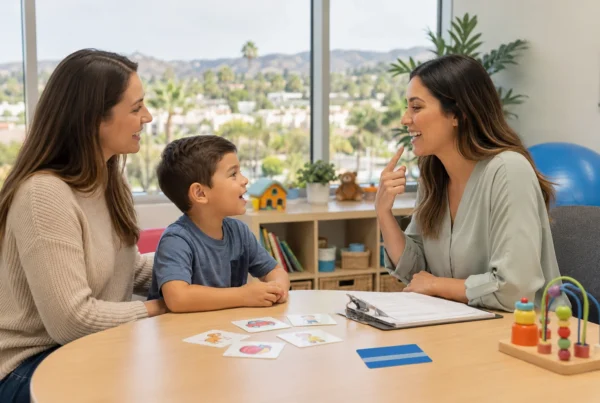
The evaluation runs in three clear stages. It opens with the clinician asking questions to get a baseline and work out where to start. Then the therapist plays with your child and watches. It closes with follow-up questions shaped by whatever came up during that play.
That middle stage looks like ordinary play because the play is the assessment. No young child performs on demand for a stranger holding a clipboard. Watching a child pick up a toy and then ask for a different one tells a clinician plenty. So the room is built to feel like a normal morning.
Nobody in that room is grading your parenting. The therapist is putting together a picture of how your child communicates today, right now. You’re in the room as the person who knows that child better than anyone. Our page on pediatric speech and language therapy covers what happens after the evaluation.
What should I bring to the first appointment?
Bring five things and the hour runs a lot smoother. Paperwork comes first, because forms finished at home give the clinician a head start. Add any prior reports, something comforting, and your own notes. Everything else can wait until somebody asks for it.
- Your completed intake forms, filled in at home rather than in the waiting room
- Any prior reports from a pediatrician, an audiologist, or a preschool teacher
- Your insurance card and a photo identification
- A comfort item your child already likes, a small toy or a blanket
- Your written notes on what you hear at home, covered in the next section
That paperwork matters more than it looks like it should. A clinician who has read your intake before the session spends the hour watching instead of interviewing. Our patient forms can be filled in at home. Printing them the night before beats thumbing through them on a phone in the waiting room.
What should I write down before we come in?
Spend ten minutes across a few days writing down the words your child says. Put the words down the way they come out, not the way you know they’re meant to sound. Then note who understands your child and who doesn’t, because that detail carries real weight. Grandparents and preschool teachers make surprisingly good tests.
Plenty of families arrive the week after a well-child visit flagged something. The American Academy of Pediatrics recommends general developmental screening at 9, 18, and 30 months. Autism screening happens at 18 and 24 months. A child understood at home and lost at preschool is telling you something specific. Bring the observation rather than your conclusion, because working that out is the clinician’s job.
Is this a screening or a full evaluation?
Ask which one you booked, because these are two genuinely different appointments. A screening is a quick pass or fail check that ends with a recommendation to test further. A full evaluation produces a written report and a measured starting baseline. Knowing which one sits on your calendar tells you what you’re walking out with.
| Screening | Full evaluation | |
| What it produces | A pass or fail with a recommendation | A written report and a starting baseline |
| Typical length | Brief, often folded into another visit | A scheduled appointment of its own |
| What you leave with | Whether further testing is advised | Findings and a proposed plan |
| What insurance sees | Often no claim at all | A billable evaluation code |
Most families who book straight with a private practice are booking the full evaluation. Screenings usually turn up through preschools and pediatric offices instead. If you’re not sure which one is on your calendar, one phone call sorts it out. Ask what the appointment produces rather than what it gets called.

How do I get my child ready?
Tell your child the truth about it in one plain sentence. Something like we’re going to meet someone who plays games about talking works fine. Don’t rehearse any words with them beforehand. A coached child hands the clinician a false picture, and the plan built on it fails.
Timing does more work than any explanation will. Book the appointment for whenever your child is normally at their best, which for most is the morning. Feed them first and leave a little margin. A hungry or hurried child shows a clinician far less than a comfortable one does.
Families make this drive from Quail Run, Madrid Del Lago, and Canyon Crest without much trouble. Our office sits off Crown Valley Parkway, near Viejo Elementary. If your child does better knowing a place first, drive past and point the building out. For what the sessions afterward look like, read inside a specialist-led session.
What do we leave with?
You won’t be walking out of the office empty-handed. The therapist talks you through what they saw before you go, and the written report follows. Five things come out of that hour. If therapy isn’t recommended, you get that answer plainly and a reason attached to it.
- A verbal summary at the end of the session, before you leave the building
- A written report with findings and a baseline, sent along afterward
- A recommendation on frequency, or a recommendation to wait and keep watching
- Starting goals written in plain language rather than clinical shorthand
- Practical things you can try at home that same week
Results vary from child to child, and no evaluation predicts how fast progress arrives. What it hands you is a starting point. Ask whatever occurs to you before you leave that room, however small it feels at the time. The therapist would far rather answer it there than have you driving home unsure.
How do you book the first appointment?
Jill Dews, MA, CCC-SLP founded this Mission Viejo practice in 2002 and holds California license SP12461. She worked inside Capistrano Unified before that, watching these same children from the school side. Our approach is play-based, therapist-led, and systematic, which is exactly why the evaluation looks like play. What you’re after on the far side of that hour isn’t a label for your child. It’s a clear picture of how they communicate and a plan you can follow.
You can reach the practice at (949) 218-0508 with any question at all before you book. Our office off Crown Valley Parkway serves South Orange County. Ask about the paperwork, or about the hour itself, and we’ll talk you through it. Schedule an Evaluation Today
Questions Mission Viejo parents ask before a first appointment
What age is best to start speech therapy?
Earlier than most parents tend to assume. CDC milestone checklists use a threshold of 75 percent or more of children. The program exists specifically to discourage a wait-and-see approach. Any missed milestone is worth raising, and age on its own never disqualifies a child from an evaluation.
Can a speech-language pathologist diagnose my child?
Inside their own field yes, and outside it no. Speech-language pathologists diagnose communication and swallowing disorders but do not diagnose medical conditions. So an evaluation can identify a speech or language disorder clearly. What it can’t tell you is whether some underlying medical cause is sitting behind it.
What should my two-year-old be saying?
The typical range here is quite broad. By age two, most children speak roughly 50 to 100 words. Being understood matters as much as counting words does. Adults who have never met your child should be able to follow about half of it.
How common are speech sound difficulties in young children?
Common enough that no family is unusual for booking. Speech sound disorders run near 8 to 9 percent among young children. Most of those disorders have no known cause at all. That share drops to roughly 5 percent by the time first grade comes around.
Related Articles