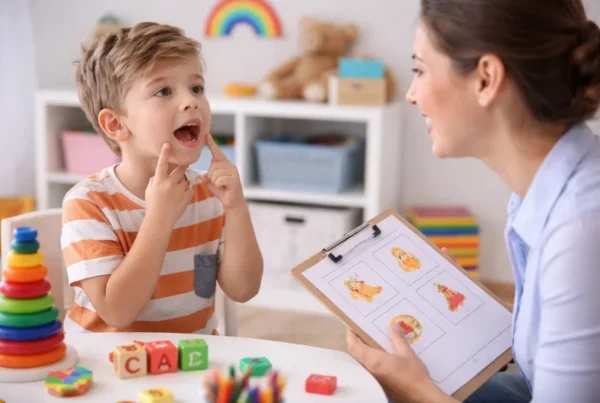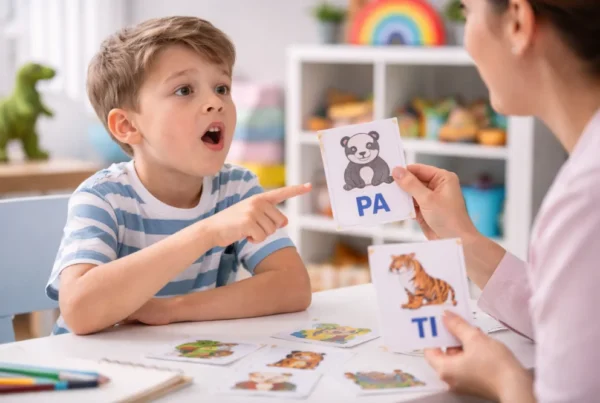


A childhood apraxia of speech diagnosis raises a lot of questions, and the biggest one is usually what treatment looks like. Jill Dews, MA, CCC-SLP has treated CAS at Let’s Talk Speech and Language Therapy in Mission Viejo since 2002. She works with families from Canyon Crest, Pacific Hills, Painted Trails, and Aegean Hills. This article walks you through the treatment methods used at Let’s Talk, what home practice involves, and how Jill tracks your child’s progress every step of the way.
Childhood apraxia of speech, or CAS, is a motor speech disorder. The child’s brain has difficulty planning the precise movements needed to produce sounds, words, and phrases consistently. CAS is not caused by muscle weakness and it is not a language disorder. Treatment must target the motor planning process directly. Standard articulation therapy alone does not produce the same results for CAS. Families on Marguerite Parkway, Crown Valley Parkway, and across the Saddleback Valley deserve a clear picture of what evidence-based CAS treatment requires before choosing a provider.
What Does Childhood Apraxia of Speech Treatment Involve at Let’s Talk?
Childhood apraxia of speech treatment at Let’s Talk centers on Dynamic Temporal and Tactile Cueing, known as DTTC. DTTC was developed specifically for CAS by researchers studying how the brain acquires new motor plans for speech. It uses intensive repetition, simultaneous cueing, and gradual reduction of support as the child builds independence. Research from the Apraxia Kids organization confirms DTTC as one of the most evidence-supported treatments for CAS.
Jill draws on the Nuffield Dyspraxia Programme and Rapid Syllable Transition Treatment based on each child’s profile. Every treatment plan at Let’s Talk starts with a formal CAS evaluation. That evaluation determines which approach your child needs, not a best guess.
How Often Does a Child With CAS Need Therapy Sessions?
Children with CAS typically need 3 to 5 sessions per week for treatment to produce real results. This is more frequent than for articulation or phonological disorders. The reason is motor learning. The brain builds motor plans through high-repetition practice spread closely in time. Wide gaps between sessions slow that process significantly.
Jill builds each session schedule around your child’s severity and your family’s availability. Families driving in from Laguna Niguel via Crown Valley Parkway or from Lake Forest along Los Alisos Boulevard often start at 3 sessions per week. Session frequency is reviewed regularly and updated based on data from each visit.
What Methods Does Let’s Talk Use to Treat CAS?
Let’s Talk uses evidence-based motor speech approaches for CAS. Jill selects each method based on the child’s age, severity, and evaluation results rather than applying a generic protocol.
- Dynamic Temporal and Tactile Cueing (DTTC)
- Nuffield Dyspraxia Programme (NDP3)
- Rapid Syllable Transition Treatment (ReST)
- Integral stimulation with simultaneous production
- Multisensory cueing including tactile, visual, and auditory input
Every approach uses high repetition of motor targets in structured conditions. Jill reduces cueing gradually as the child builds independence. She tracks response to each method at every session and adjusts when progress stalls or when a child is ready for the next level.
How Does Jill Measure Your Child’s Progress in CAS Treatment?
Jill measures CAS progress through direct data collection at every session, not through general observation. She records accuracy on target words and sounds during each visit. She tracks those numbers across sessions to determine whether the approach is working and when to advance targets. You never have to guess how your child is doing.
| Progress Stage | What Jill Measures | Typical Timeframe |
| Acquisition | Accuracy with full cueing in structured drill | Weeks 1 to 4 |
| Stabilization | Accuracy with reduced cueing in structured tasks | Weeks 4 to 8 |
| Generalization | Accuracy in spontaneous speech without prompting | Months 2 to 6 |
| Maintenance | Consistent accuracy across all speaking contexts | Months 6 and beyond |
How quickly a child moves through these stages depends on severity. A child with mild CAS who starts early may reach generalization within a few months. A child with severe CAS may spend longer in acquisition. Jill reviews progress with you every 6 to 8 weeks and adjusts goals based on the data.
What Do Parents Do Between CAS Sessions to Help Their Child?
Home practice is not optional in CAS treatment. What you do between sessions directly affects how fast your child progresses. Jill builds a specific home program for every family and updates it at each visit.
- Practice sessions should be short, frequent, and consistent
- 5 to 10 minutes twice daily outperforms one longer session per week
- Target words are chosen by Jill based on current therapy goals
- You use the same cueing methods Jill uses in the clinic
- The Let’s Talk Early Intervention App provides structured at-home support
Parents at Let’s Talk are active partners, not waiting room observers. Jill trains every caregiver in the cueing methods from each session so home practice builds on clinical work rather than working against it.
When Will My Child With CAS Stop Needing Therapy?
Most children with CAS need therapy for 1 to 3 years. Severity and consistency of home practice are the two biggest factors. Children with mild CAS who start early and practice daily can make significant progress in under a year. Children with moderate to severe CAS typically need longer treatment with regular reassessment along the way.
Jill does not continue therapy without data showing forward movement. If a child plateaus across several sessions, she reassesses the approach before going further. Families from Pacific Hills and Painted Trails in Mission Viejo, and families making the drive from Laguna Hills along Alicia Parkway or from Aliso Viejo via the 73 to Crown Valley Parkway, get a straight answer about their child’s progress every time.
Your Child Deserves Evidence-Based CAS Treatment at Let’s Talk
Parents navigating a CAS diagnosis deserve a therapist who uses proven methods, collects real data, and communicates clearly about what their child needs. Jill Dews, MA, CCC-SLP has specialized in childhood apraxia of speech at Let’s Talk since 2002. She serves families across Mission Viejo, Laguna Niguel, Aliso Viejo, and the South Orange County corridor along the I-5 and the 241 every day.
Call Let’s Talk at (949) 218-0508 to schedule a CAS evaluation today. Jill Dews, MA, CCC-SLP and her team at letstalkspeechandlanguagetherapy.com will walk you through the findings and build a plan around your child’s needs. Take the first step now and give your child access to the CAS treatment they deserve.
Frequently Asked Questions
What treatment works best for childhood apraxia of speech?
Motor-based approaches that use high repetition, systematic cueing, and structured practice are the most effective treatments for CAS. DTTC is one of the most researched of those methods and is what Jill Dews uses at Let’s Talk in Mission Viejo. The research is clear that treatment has to be built on motor learning principles, and the evidence behind motor-based CAS treatment is well-established. The most important thing is finding a therapist who selects a method based on a formal CAS evaluation rather than applying a generic approach.
How long will my child need speech therapy for CAS?
Most children with CAS need therapy for 1 to 3 years, though that range depends heavily on severity and how consistently home practice happens. Children with mild CAS who start early can make significant gains in under a year. Early diagnosis and intensive therapy give children the best outcomes, and the research on CAS treatment timelines reflects that consistently across the literature. Regular reassessment is what keeps the plan aligned with where your child actually is.
How many times a week does my child need to come in for CAS therapy?
Children with CAS typically need 3 to 5 sessions per week to make meaningful progress. That frequency is higher than for most speech disorders because CAS is a motor learning problem that requires practice in close intervals to build new motor plans. At Let’s Talk on Las Ramblas in Mission Viejo, Jill Dews builds every session schedule around your child’s severity and your family’s actual availability. Motor learning research on session frequency consistently supports intensive practice as a core requirement for CAS treatment.
Will my child ever speak normally with the right treatment?
Many children with CAS make significant progress with consistent evidence-based therapy and strong home practice between sessions. Children with mild CAS who begin treatment early often reach communication skills that meet their everyday needs at home and at school, and some achieve full resolution of symptoms. Early intervention is the strongest predictor of positive long-term outcomes, and the clinical data on apraxia recovery supports starting treatment as soon as a diagnosis is confirmed. The earlier a child starts, the better the results tend to be.
Related Services
Related Articles