


Speech or language delays show up when a child is not communicating the way most children their age typically do. Speech delay signs can include difficulty being understood, limited words, or trouble understanding what others say. Many parents notice these signs quietly at first and wonder if they should wait or look for guidance.
At Let’s Talk Speech and Language Therapy, families across Mission Viejo often come in with this exact concern. They are not looking for a diagnosis right away. They want to know which signs matter, what is part of normal development, and when an evaluation could be helpful.
Experience and Expertise You Can Trust
This practice is led by Jill Dews, M.A., CCC-SLP, a licensed Speech-Language Pathologist with more than twenty years of experience supporting children and families. Jill founded Let’s Talk Speech and Language Therapy in 2002 with a focus on early intervention and practical guidance for parents.
Before opening her private practice, Jill worked in the Capistrano Unified School District, collaborating with teachers and families across a wide range of communication needs. She earned her Master’s degree in Communicative Disorders from California State University, Long Beach. She also created the Let’s Talk Early Intervention App to help families support speech and language development at home.
Common Speech Delay Signs Parents Often Notice
Parents are usually the first to sense when something does not feel quite right. Speech delay signs often appear during everyday moments like playtime, mealtime, or story time. Noticing these signs early can help parents decide whether to seek more information.
Common speech delay signs include:
- Speech that is difficult for unfamiliar listeners to understand
- Fewer words than expected for age
- Limited use of two-word combinations
- Frustration when trying to communicate
- Reliance on gestures instead of words
These signs do not mean a child has done anything wrong. They simply suggest that extra support may help communication feel easier.
Signs of a Language Delay Beyond Speech Sounds
Some children pronounce sounds clearly but still struggle with language. Language delay signs often involve understanding and using words rather than how speech sounds. These challenges can be harder to spot at first.
Children with language delays may have trouble following directions or answering questions. They might seem inattentive when spoken to or struggle to learn new words. Speech therapy focuses on building understanding as well as expression.
Social and Interaction-Based Speech Delay Signs
Communication is about more than words alone. Speech delay signs can also appear in how children interact with others. These challenges may affect play, friendships, and classroom participation.
Some children struggle with turn-taking or staying on topic. Others avoid talking in social situations or have difficulty responding appropriately. Speech therapy provides guided practice in a supportive setting to build these skills.
What Happens During a Speech and Language Evaluation
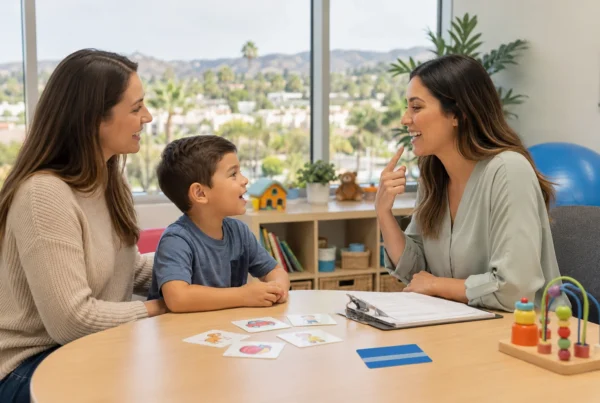
A speech and language evaluation is designed to feel calm and child-friendly. The therapist observes your child during play and conversation while parents share concerns, history, and goals. This helps create a full picture of communication strengths and challenges.
Standardized tools may be used, but they are always balanced with real interaction. The evaluation is not about labeling a child. It is about understanding how your child communicates right now and identifying helpful next steps.
How Speech Therapy Helps With Speech and Language Delays
Speech therapy sessions are active and engaging. Therapy often looks like play, but each activity is chosen with a specific communication goal in mind. Children learn best when they feel safe and supported.
Therapists model language, encourage attempts, and reinforce progress. Parents are often involved so strategies can be used at home. This collaboration helps skills carry over into daily routines.
How Parents Can Support Progress at Home
Parents play an important role in helping children overcome speech or language delays. Everyday routines offer many opportunities to support communication. Home support does not need to feel overwhelming or complicated.
Helpful ways parents can support progress include:
- Modeling clear and simple language during routines
- Expanding on what a child says instead of correcting
- Reading together and talking about pictures and stories
- Using playtime and meals as natural conversation moments
Consistent support helps children use new skills across different settings. Small interactions throughout the day add up over time.
When to Seek an Evaluation Instead of Waiting
Some parents hope speech delay signs will resolve on their own. While development varies, waiting can sometimes increase frustration for both children and parents. An evaluation provides clarity and reassurance.
Speech therapy is helpful at many ages, not just early childhood. Older children can also benefit from targeted support that builds confidence and communication skills. An evaluation helps determine the best timing.
Speech Therapy Support at Let’s Talk Speech and Language Therapy
At Let’s Talk Speech and Language Therapy, services are personalized and family-centered. Speech therapy supports speech clarity, language development, and social communication based on each child’s needs. Therapy plans focus on strengths as well as areas that need support.
Families across Mission Viejo choose the practice for its experience and compassionate approach. Parents are treated as partners throughout the process. This collaboration supports steady and meaningful progress.
Speech Delay Signs Compared to Typical Development
Parents often wonder whether what they are seeing is a true delay or typical development. Comparing patterns can help clarify when support may be helpful.
| Area | Typical Development | Speech or Language Delay Signs |
| Speech Clarity | Mostly understood by age peers | Often hard to understand |
| Vocabulary | Growing word use | Limited or slow word growth |
| Understanding | Follows basic directions | Difficulty understanding language |
| Interaction | Engages in simple conversation | Limited responses or avoidance |
An evaluation helps interpret these differences in a supportive way. It replaces guesswork with clear information.
How Early Support Builds Long-Term Confidence
Speech and language delays affect more than communication alone. They can influence confidence, learning, and relationships. Speech therapy focuses on building skills that support long-term success.
As children gain communication tools, they often become more confident and engaged. These skills support participation at school and with peers. Parents frequently notice reduced frustration and stronger connection.
Taking the Next Step
If you are noticing speech delay signs and feeling unsure what to do next, support is available. A speech and language evaluation can provide clarity and guidance. You do not have to navigate this alone.
At Let’s Talk Speech and Language Therapy, families work with professionals who listen and care. Jill Dews and her team focus on real-life communication and meaningful progress. Scheduling a consultation is a simple next step.
Frequently Asked Questions
What are the earliest signs of a speech or language delay?
Parents ask this because they want to act at the right time. Early speech delay signs can include limited words, difficulty being understood, or trouble understanding language. An evaluation helps determine whether support is needed.
Sources: https://www.asha.org/public/speech/development/overview/
https://www.cdc.gov/ncbddd/actearly/milestones/index.html
Is a speech delay the same as a language delay?
Parents often hear these terms used together and feel confused. Speech delays affect how sounds are produced, while language delays affect understanding and word use. Speech therapy can address both areas.
Sources: https://www.asha.org/public/speech/disorders/
https://www.cdc.gov/ncbddd/childdevelopment/index.html
Can children outgrow speech or language delays?
Some children make progress over time, but others benefit from speech therapy support. Early intervention often helps reduce frustration and build skills more efficiently. An evaluation provides clarity.
Sources: https://www.asha.org/public/earlyintervention/
https://www.cdc.gov/ncbddd/childdevelopment/screening.html
What should I do if I am unsure about my child’s speech?
Parents want reassurance without pressure. Scheduling an evaluation does not commit you to therapy. It simply provides information and guidance.
Sources: https://www.asha.org/public/speech/parent-guide/
https://www.cdc.gov/parents/essentials/communication/index.html