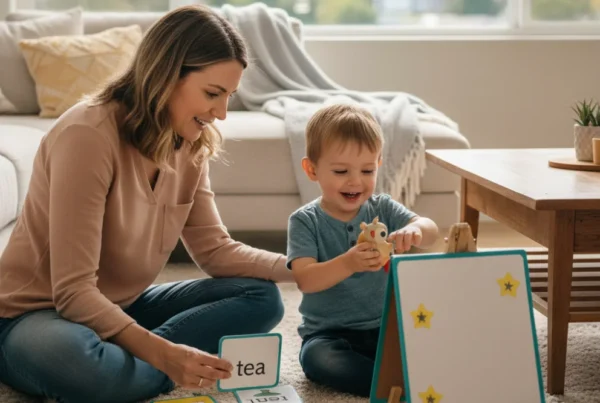

Phonological processing difficulties affect how a child’s brain hears, organizes, and uses speech sounds. When sound patterns do not develop as expected, speech can remain unclear and reading can later become challenging. Parents in Mission Viejo often notice that their child sounds younger than peers and wonder whether this is simply a phase or something that deserves closer attention.
This guide reflects the clinical experience of Jill Dews, M.A., CCC-SLP, founder of Let’s Talk Speech and Language Therapy. Since 2002, Jill has worked with families throughout Mission Viejo, including Pacific Hills, Painted Trails, Canyon Crest, and nearby neighborhoods such as Ladera Ranch and Lake Forest. Her background in both school-based and private therapy settings allows her to connect speech clarity concerns with classroom learning and reading development in a practical way.
Experience and Expertise You Can Trust
Jill Dews is a licensed Speech-Language Pathologist with more than two decades of pediatric experience. She founded Let’s Talk Speech and Language Therapy to provide early, evidence-based support for children in Mission Viejo and surrounding communities. Her work focuses on speech sound disorders, phonological awareness, and early literacy foundations.
Before opening her private practice, Jill worked in the Capistrano Unified School District, where she collaborated with teachers, specialists, and families across a wide range of communication needs. She earned her Master’s degree in Communicative Disorders from California State University, Long Beach, and she continues to integrate current research into her clinical practice. Families appreciate her calm guidance and clear explanations during evaluations and therapy sessions.
What Is Phonological Processing and How Is It Different From Articulation?
Phonological processing refers to the way the brain organizes and applies the sound system of a language. It involves recognizing patterns of sounds and using them consistently in speech. Articulation, in contrast, refers to the physical movement of the lips, tongue, and jaw to produce specific sounds.
A child with articulation difficulty might struggle with a single sound such as “r.” A child with phonological processing difficulty often shows patterns across several sounds. For example, a child might say “tat” instead of “cat” or “poon” instead of “spoon.” Some of these patterns are typical at younger ages, but when they persist beyond expected developmental windows, speech may remain hard to understand.
Early Signs in Toddlers and Preschoolers
Early signs of phonological processing difficulties often appear before kindergarten. Parents in Arroyo Vista, Evergreen Ridge, and Pacific Knolls frequently report that their child’s speech is difficult for unfamiliar listeners to understand. Limited sound variety and frequent sound omissions are common indicators.
Common early signs include:
- Dropping final consonants, such as saying “ca” instead of “cat”
- Replacing harder sounds with easier ones, such as “t” for “k”
- Simplifying consonant clusters, such as saying “poon” instead of “spoon”
- Using only a small range of consonant sounds
- Struggling to repeat longer, multi-syllable words
By around age three, most familiar listeners should understand a child most of the time. By age four, unfamiliar adults should understand much of what the child says. If clarity remains significantly reduced after age four, a speech evaluation is recommended.
Signs in Preschool and Early Elementary Years
Between ages four and seven, many early phonological patterns should naturally fade. When they persist, they often become more noticeable in structured settings such as school. Teachers may report difficulty understanding the child during group discussions or reading activities.
Children may show inconsistent pronunciation of the same word across different situations. They may also avoid speaking in class or become frustrated when asked to read aloud. Parents in Alta Finisterra and Madrid Del Lago sometimes interpret this hesitation as shyness. In many cases, unclear speech or weak sound awareness contributes to the reluctance.
How Phonological Processing Connects to Reading
Phonological processing plays a direct role in how children learn to read and spell. When the brain struggles to organize and distinguish speech sounds, it becomes harder to connect those sounds to letters on a page. Over time, weak sound awareness can affect decoding, spelling accuracy, and reading fluency.
| Area | Typical Development | Possible Concern |
| Speech Clarity | Mostly understood by age 4 | Frequently unclear after 4 |
| Word Patterns | Simplifications decrease over time | Patterns persist beyond expected age |
| Sound Awareness | Can rhyme and blend simple sounds | Difficulty with rhyming or blending |
| Early Reading | Learns letter sounds steadily | Ongoing decoding difficulty |
When phonological processing is supported early, children often show stronger progress in both speech clarity and reading development. A coordinated approach between speech therapy and classroom instruction helps reinforce sound awareness skills in meaningful ways. Addressing these concerns early reduces frustration and supports long-term academic confidence.
When to Seek a Speech and Language Evaluation
Parents do not need a formal diagnosis before seeking guidance. If speech remains hard to understand after age four, sound patterns are not improving, or early reading feels unusually difficult, an evaluation is appropriate. Acting early often reduces frustration and supports stronger classroom participation.
A phonological processing evaluation typically includes a detailed case history, speech sampling, and analysis of sound patterns. The therapist may also assess phonological awareness skills that affect reading. Families in Quail Run and Greystone may seek private evaluations or request school-based assessments. Early intervention supports clearer speech and stronger academic outcomes.
How Speech Therapy Helps Children with Phonological Processing Difficulties
Speech therapy addresses the underlying sound system in structured and systematic ways. Evidence-based approaches such as minimal pairs therapy and the cycles approach help children recognize and produce correct sound contrasts. Therapy often integrates phonological awareness activities to strengthen reading readiness.
Sessions are designed to be engaging and developmentally appropriate. Parents are included in the process and receive practical strategies for home practice. At Let’s Talk Speech and Language Therapy in Mission Viejo, therapy plans reflect both school expectations and family goals.
What Parents Can Do at Home
Home support strengthens therapy progress and reinforces new sound patterns. Daily routines provide natural opportunities to build sound awareness skills. Short, consistent activities are more effective than long drilling sessions.
Helpful home strategies include:
- Playing rhyming games during everyday activities
- Using sound-focused games such as “I spy something that starts with /s/”
- Reading books that highlight repeating sound patterns
- Practicing therapist-guided minimal pair contrasts
- Encouraging clear speech modeling without excessive correction
Keep practice sessions brief and positive so that your child associates sound practice with encouragement rather than pressure. Celebrate effort and gradual improvement instead of focusing only on perfect production of sounds. When children feel supported and understood, consistent reinforcement at home helps strengthen new speech patterns and supports lasting change over time.
Moving Forward with Confidence in Mission Viejo
If your child’s speech sounds younger than peers or reading feels more difficult than expected, you are not alone in asking questions. Phonological processing difficulties reflect how the brain organizes sounds, not a lack of intelligence or effort. Clear speech and strong sound awareness build confidence in both academic and social settings.
At Let’s Talk Speech and Language Therapy, your child remains the hero of this story. Jill Dews serves as the guide who helps families move from uncertainty to clarity with a structured plan and compassionate support. When you choose to schedule an evaluation, you take a confident step toward helping your child communicate and learn more comfortably. Call (949) 218-0508 to schedule a speech evaluation in Mission Viejo today.
Frequently Asked Questions
Is my child’s speech normal for their age?
Parents often ask this because development varies and comparisons can feel confusing. What truly matters is whether speech patterns are gradually improving and becoming easier to understand over time. A more helpful question is whether persistent sound patterns are limiting communication or confidence in daily life. Phonological processing difficulties are concerning when speech remains difficult to understand after age four or when patterns are not fading as expected. Early evaluation supports stronger outcomes according to the American Speech-Language-Hearing Association and the Centers for Disease Control and Prevention.
Do phonological processing difficulties affect reading?
Parents worry about reading because academic success influences long-term confidence. A better question to ask is whether sound awareness skills are supporting decoding and spelling development. Phonological processing forms the foundation for phonological awareness, which is essential for learning to read. Research from ASHA and the National Institute of Child Health and Human Development shows a strong connection between sound processing skills and decoding ability. Early support improves both speech clarity and literacy outcomes.
What is the difference between articulation and phonological difficulties?
Parents often hear both terms used and feel unsure which one applies to their child. A more strategic question is whether the difficulty involves a single sound or a broader sound pattern. Articulation difficulties involve motor production of individual sounds, while phonological processing difficulties involve patterns across multiple sounds. Accurate diagnosis guides effective treatment planning and prevents confusion between the two.
When should I contact a speech therapist in Mission Viejo?
Parents sometimes hesitate because they worry about overreacting. A more helpful question is whether waiting might increase frustration or academic impact. If speech remains hard to understand after age four, patterns are not improving, or reading skills lag behind peers, scheduling an evaluation is appropriate. Early intervention improves communication and learning outcomes.